
Om symbol in gold on maroon

॥ श्री हनुमान चालीसा ॥

Learn Chalisa

I’m learning the Hanuman Chalisa — slowly, honestly, one verse at a time — and sharing the whole journey: the verse in Devanagari, transliteration so you can read along, the meaning in plain English, a word-by-word gloss, and the questions a beginner actually asks.

Read the full Chalisa — all 43 sections Read the weekly letter

Why this exists

A few months ago I started reciting the Hanuman Chalisa every morning. I could get through it — but if you had stopped me mid-verse and asked what I had just said, I would have had almost nothing to tell you. The sounds were there; the meaning wasn’t.

So instead of only memorising, I decided to learn it — one verse at a time, word by word, for as long as it takes. This site is that notebook, in public.

How every verse is taught

🪔 Devanagari

The verse as it is written, so your eyes learn the script as you recite.

✍️ Transliteration

The same verse in Roman letters, so anyone can read along and say it aloud.

🌿 Plain-English meaning

What the verse actually says — no Sanskrit degree required.

🔎 Word by word

A gloss for every word, so you can see exactly how the meaning is built.

We begin at the beginning

Doha 1

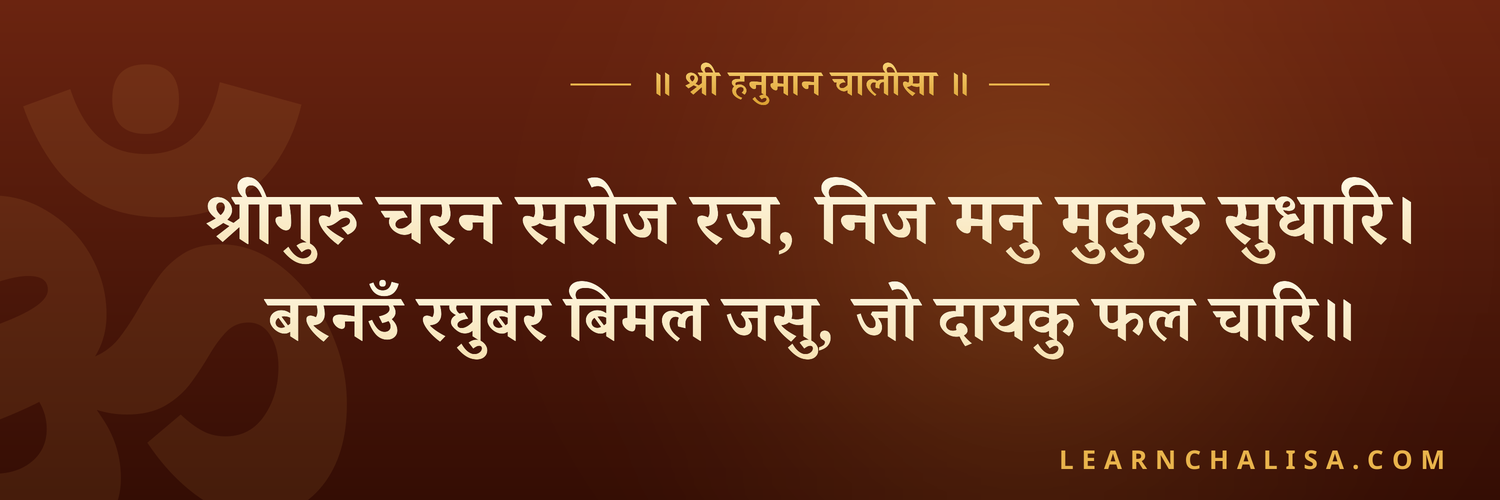
श्रीगुरु चरन सरोज रज, निज मनु मुकुरु सुधारि।
बरनउँ रघुबर बिमल जसु, जो दायकु फल चारि॥

Shri guru charan saroj raj, nij manu mukur sudhaari. Barnaun Raghubar bimal jasu, jo daayak phal chaari.

Cleansing the mirror of my mind with the dust of my guru's lotus feet, I sing the pure glory of Raghubar (Ram) — glory that bestows the four fruits of life.

Word by word

श्रीगुरु (the revered guru) · चरन (feet) · सरोज (lotus) · रज (dust) · निज (my own) · मनु (mind) · मुकुरु (mirror) · सुधारि (having cleansed, purified) · बरनउँ (I sing, describe) · रघुबर (Ram, best of Raghu's line) · बिमल (pure, spotless) · जसु (glory) · जो (which) · दायकु (giver, bestower) · फल (fruit) · चारि (four)

The question I asked: Why does the Chalisa begin with cleaning a mirror instead of with Hanuman himself? Before strength, before devotion, before any request — the mirror gets cleaned. A dusty mirror can’t reflect anything truly, and a cluttered mind can’t learn anything deeply. Verse one is the method of the whole book, hidden in its first line.

Continue — all 43 sections, in order →

What’s inside

The Hanuman Chalisa has 43 sections: 2 opening dohas, 40 chaupais, and 1 closing doha. (“Chalisa” itself means forty — for the forty chaupais at its heart.) Every section is here, in order, in the same four layers — and the word-by-word gloss can be switched on or off on the full-text page, so you can test yourself as you learn.

This is a student’s notebook, not a master’s teaching. I’m not a scholar, priest, or guru, and this is not a translation copied from a book — it’s one beginner’s honest record. Where I get something wrong, I’ll correct it in the open.

Learn it with me

One verse a week, in full, in the free weekly letter on Substack — and smaller pieces on X, YouTube, TikTok and Facebook, all as @LearnChalisa.